
Being granted a permanent visa, such as a Skilled Independent visa (subclass 189), a Skilled Nominated visa (subclass 190) or an Employer Nomination Scheme visa (subclass 186), is a major milestone. Your visa works on two different time frames. Your permanent residence continues while you remain in Australia, but your right to travel on the visa is limited. This article explains the difference and how to plan your travel.
Your permanent visa lets you stay indefinitely
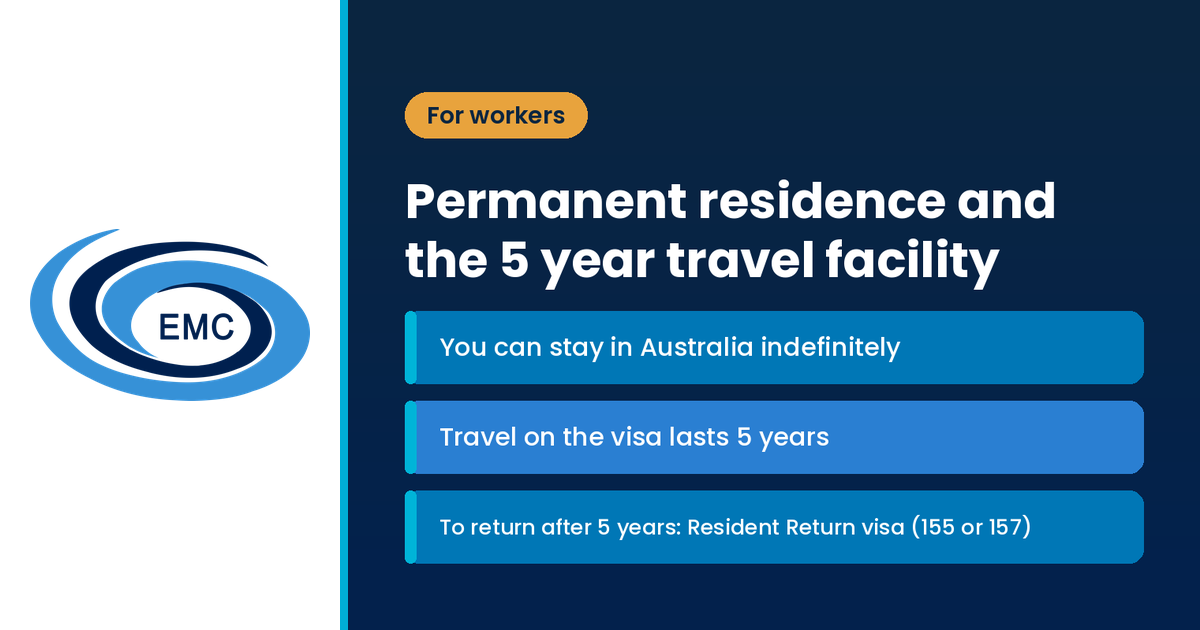
Home Affairs states that these are permanent visas that let you stay in Australia indefinitely. You become a permanent resident on the day the visa is granted.
For citizenship purposes, Home Affairs says your permanent residence starts on the day the visa is granted, if you are in Australia at that time. If you were outside Australia when the visa was granted, it starts on the day you enter Australia on the visa.
The travel facility lasts five years
Home Affairs explains that the visa has a travel component that lets you travel in and out of Australia as many times as you want for five years from the date of grant. After five years, you will need a Resident Return visa (subclass 155 or 157) to re-enter Australia as a permanent resident.
In other words, while you stay in Australia, the end of the travel facility does not end your permanent residence. It ends your ability to leave and come back into Australia as a permanent resident on that visa.
Home Affairs states that if you leave Australia after your permanent visa travel facility has expired, you will not be able to return to Australia as a permanent resident unless you are granted a Resident Return visa before you arrive. This applies to the 189, 190 and 186 alike.
Who needs a Resident Return visa
If you are already in Australia as a permanent resident and do not wish to travel, you do not need to apply for a Resident Return visa. The visa matters when you want to leave Australia and come back as a permanent resident after your original travel facility has ended. It can also be available to some former permanent residents, but Australian citizens are not eligible.
The length of the travel facility on a Resident Return visa depends on your circumstances. Home Affairs states that if you have been in Australia for a total of at least two years in the last five years as a permanent visa holder or Australian citizen, you meet the residence requirement and will be given a five-year travel facility. People who do not meet that requirement can only be given a shorter travel facility in certain circumstances: up to 12 months if they have substantial ties with Australia that benefit Australia, or if a family member holds or has applied for a Resident Return visa and meets the requirements, or 3 months on a subclass 157 visa if there are compelling and compassionate reasons for their absence.
Any travel facility remaining on a previous visa cannot be carried over to a new Resident Return visa, and a travel facility cannot be extended. Home Affairs warns that returning without a permanent visa and a valid travel facility, for example on a visitor visa, might affect your entitlements as a permanent resident and your ability to meet residence requirements for citizenship.
Practical steps
Check the date your travel facility expires. You can do this in Visa Entitlement Verification Online, known as VEVO.
Plan any overseas travel near the five-year mark carefully, and allow time to apply for a Resident Return visa before you need it. Home Affairs says applications that meet the residence requirement are generally processed within 5 working days, while others can take 12 weeks or more.
If you are eligible, consider applying for Australian citizenship. Home Affairs suggests that, instead of relying on further Resident Return visas, you may wish to consider your eligibility for citizenship so you can travel on an Australian passport.
Your permanent visa may also allow you to enrol in Medicare, and you may be able to sponsor eligible relatives to come to Australia.
If you are unsure of your dates or your options, we can review them with you.
Read our guide to work and skilled visas
Read about the Resident Return visa
Read about the Skilled Independent visa (subclass 189)
Read about Australian citizenship
Official sources
Read the Home Affairs page for the Resident Return visa (subclasses 155 and 157)
Read the Home Affairs page for the Skilled Independent visa (subclass 189)
Read the Home Affairs page for the Skilled Nominated visa (subclass 190)
Read the Home Affairs page for the subclass 186 Temporary Residence Transition stream
To talk about your situation, Book a Consultation from the top of this page, or message us on WhatsApp on +61 478 278 410.
General information only, not legal advice. EMC Australia, MARN 1800335.
Book a Consultation
General information only, not legal advice. EMC Australia, MARN 1800335.