
Businesses in some regional areas of Australia face skills and labour shortages that the standard skilled migration program does not fully meet. A Designated Area Migration Agreement, known as a DAMA, is one way the Australian Government responds to those regional needs. Home Affairs describes it as a formal agreement between the Australian Government and a state or territory government or regional authority, giving access to more occupations than the standard skilled migration program. This article explains how a DAMA is structured, the order of steps for employers, and what to keep in mind as arrangements change.
How a DAMA is structured
Home Affairs describes a DAMA as a two-tier framework covering a defined regional area. The first tier is an overarching five-year head agreement between the Australian Government and the region's Designated Area Representative, often called the DAR. Home Affairs states that the DAR is usually a state or territory government or a regional body, such as a chamber of commerce, a Regional Development Australia office or a local government council.
The head agreement contains a range of occupations, along with agreed terms and concessions to skilled visa eligibility criteria. Once a head agreement is in place, businesses in the region may seek individual DAMA labour agreements under its terms.
Individual labour agreements for employers
The second tier is the individual labour agreement between the Australian Government and an endorsed employer operating within the designated region. Home Affairs states that these individual agreements are generally in effect for five years. They use the Skills in Demand visa (subclass 482), the Skilled Employer Sponsored Regional (Provisional) visa (subclass 494) and the Employer Nomination Scheme visa (subclass 186) programs.
Where a DAMA labour agreement is approved, Home Affairs says the business will be able to nominate and sponsor skilled and semi-skilled overseas workers for certain occupations, within the range of occupations covered by that region's head agreement.
Endorsement from the DAR comes first
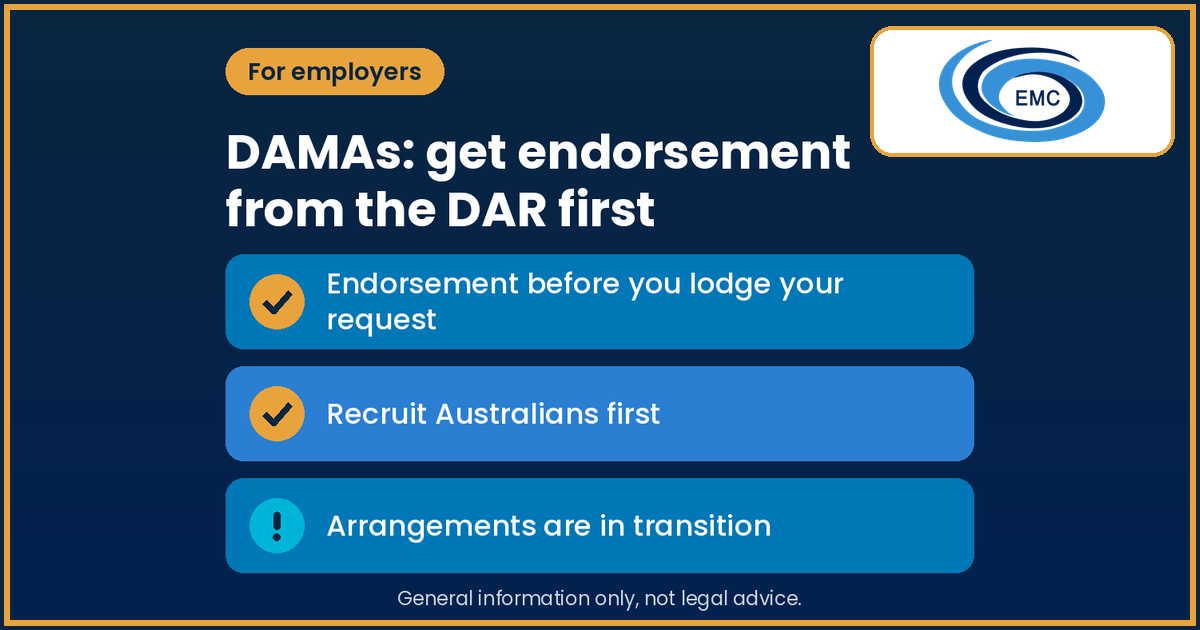
The order of steps matters. Home Affairs states that employers must seek and gain endorsement from the DAR before lodging a labour agreement request online through ImmiAccount. The online form in ImmiAccount sets out the requirements and supporting documents needed for the request.
Home Affairs explains that DARs work closely with employers and stakeholders in their region to understand local labour needs and broader community views, and that they endorse individual requests from businesses before those businesses lodge a request with Home Affairs. Contacting the DAR for your region early is therefore an important first step.
Recruiting Australians first
Home Affairs states that DAMAs ensure employers recruit Australian citizens and permanent residents as a first priority. Among other things, employers must show a genuine attempt to recruit Australians before accessing a DAMA labour agreement.
In practice, this means keeping clear records of your efforts to recruit locally. This evidence supports both your request for endorsement from the DAR and your labour agreement request.
When a DAMA will not be endorsed
Home Affairs states that a DAMA will not be endorsed where the industry is covered by an industry labour agreement, which includes fixed agreement terms. If your business operates in an industry that has its own industry labour agreement, check that pathway before approaching the DAR.
Arrangements are changing
Home Affairs states that it is currently supporting the transition to state and territory-led DAMAs. Because these arrangements are changing, check the current Home Affairs page and contact the DAR for your region for up-to-date requirements before you start preparing a request.
Planning your next steps
Before you approach the DAR, confirm that your business operates within a designated region, check that the occupations you need are within the range covered by the head agreement, and gather your local recruitment records. We can help you prepare for endorsement and for the labour agreement request.
Read our guide to work and skilled visas
Read what employers must show for a company specific labour agreement
Read about the Skilled Employer Sponsored Regional visa (subclass 494)
Official sources
Read the Home Affairs page on Designated Area Migration Agreements
Read the Home Affairs overview of labour agreements
To talk about your situation, Book a Consultation from the top of this page, or message us on WhatsApp on +61 478 278 410.
General information only, not legal advice. EMC Australia, MARN 1800335.
Book a Consultation
General information only, not legal advice. EMC Australia, MARN 1800335.