
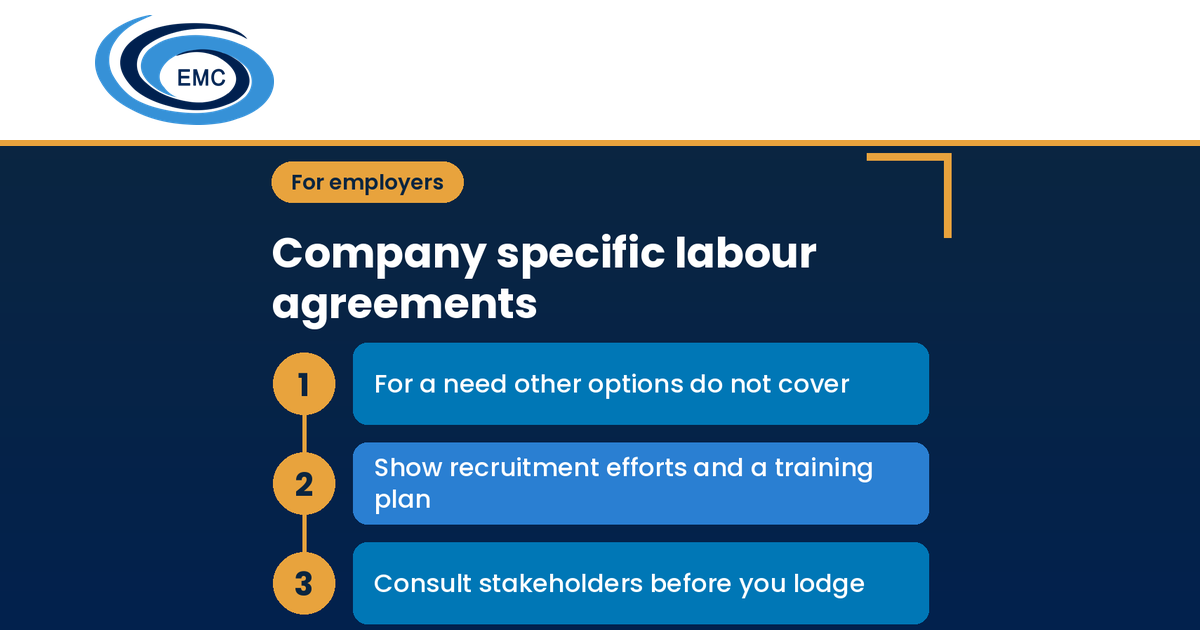
Some businesses have a genuine need for skilled workers from overseas that the usual sponsorship options do not meet. For these employers, Home Affairs offers the company specific labour agreement. It is a significant undertaking, and Home Affairs is clear that it is not the first option to consider. This article explains when a company specific labour agreement may fit, what your business must show, and how to consult stakeholders before you lodge a request.
When a company specific labour agreement may fit
Home Affairs states that a company specific labour agreement should not be considered if you are able to use the standard skilled visa programs, or if you are covered by an industry labour agreement or a Designated Area Migration Agreement, often called a DAMA.
According to Home Affairs, this type of agreement is for an employer where a genuine skills need is not already covered by an industry labour agreement, where a DAMA or project agreement is not in place, and where the occupations in shortage are not already available under the standard skilled visa programs, unless a strong and compelling business case has been provided.
Working through these points first can save your business considerable time and effort.
Showing an exceptional need
Home Affairs states that you must show an exceptional need that cannot be met by Australian workers. Your evidence should show the niche skills you seek from overseas, your many and diverse recruitment efforts, and a detailed job description, including the tasks of the role.
The positions must be at skill level 1 to 4 of the Australian and New Zealand Standard Classification of Occupations, known as ANZSCO. For businesses located in Category 3 regional areas of Australia, Home Affairs says positions equivalent to ANZSCO skill level 5 may be considered in exceptional situations.
A temporary solution with a training plan
Home Affairs describes the company specific labour agreement as a temporary solution only. You must show that you have a plan in place to train and employ Australians, so that you do not need a future labour agreement.
Home Affairs also states that you must show that workers from overseas will not be more than one-third of your total workforce. Its older Labour Agreement information guide sets limits that vary by business location, so confirm the limit that applies to your business before you lodge.
A realistic training plan, supported by evidence, is central to a well-prepared request. It shows how your business intends to build its own Australian workforce over time.
A business in good standing
Home Affairs states that your business must be an Australian registered business with good standing, and that you must show it has been lawfully and actively operating in Australia for at least 12 months. You must also show evidence of financial viability provided by a chartered or certified practising accountant.
You must also show that you can support the number of workers from overseas you seek, and that there is no adverse information about your business. Home Affairs states that the business must not have broken a law in any Australian jurisdiction or be under investigation for breaking the law, must not be insolvent, and must not have given false or misleading information to any appropriate authority.
Consulting stakeholders before you lodge
Consultation is a required step. Home Affairs states that you must consult all relevant stakeholders, which may include the industry body, the relevant union and any community group the agreement affects.
The information you give stakeholders should cover the number of workers from overseas you seek in each year of the agreement and their occupations, the location of the workplace, the proposed salary, any relevant awards and how you worked out the salary, any concessions you seek, and details of the training you will give your Australian workforce to reduce your reliance on workers from overseas.
Home Affairs asks you to give stakeholders 10 working days to respond. If there is no response, you should follow up and allow a further 5 working days. When you lodge your request, include detailed information about your consultation, including copies of your written requests to stakeholders and any responses. Home Affairs states that requests submitted without consultation will be returned without assessment.
Planning your next steps
Before investing time in a request, check whether a standard skilled visa program, an industry labour agreement or a DAMA could meet your needs. If a company specific labour agreement does appear to fit, start gathering evidence of your recruitment efforts and preparing your training plan early, and allow enough time for stakeholder consultation.
We can help you work out whether a labour agreement suits your business before you invest time in a request.
Read our guide to work and skilled visas
Read about the Skills in Demand visa (subclass 482)
Official sources
Read the Home Affairs page on company specific labour agreements
Read the Home Affairs overview of labour agreements
To talk about your situation, Book a Consultation from the top of this page, or message us on WhatsApp on +61 478 278 410.
General information only, not legal advice. EMC Australia, MARN 1800335.
Book a Consultation
General information only, not legal advice. EMC Australia, MARN 1800335.