
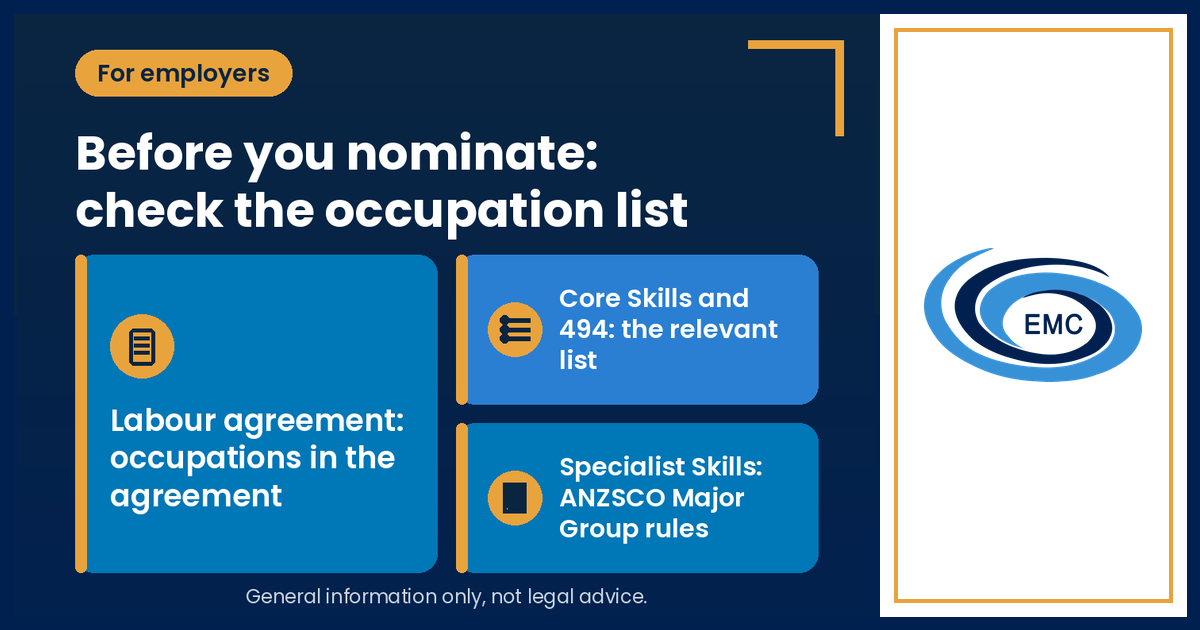
When a business decides to sponsor an overseas worker, one of the first questions is whether the occupation can be nominated at all for the visa and stream you plan to use. Each visa and stream has its own rule, and checking it early can save time and help avoid a refusal.
What Home Affairs says about occupations
Home Affairs states that employers using labour agreements can only nominate overseas workers in occupations specified in their labour agreement. For other visa types and streams, skilled occupation lists limit which occupations can be nominated. You must also meet salary and employment requirements, and other nomination requirements depend on the visa you choose.
Skills in Demand visa: Core Skills stream
For the Core Skills stream of the Skills in Demand visa (subclass 482), the occupation must be on the Core Skills Occupation List. This list is set by the Minister in a legislative instrument, and the worker's position must meet any conditions the list sets for that occupation, as the list stands when you nominate.
Skills in Demand visa: Specialist Skills stream
The Specialist Skills stream does not use an occupation list. Instead, the occupation must be in Major Group 1, 2, 4, 5 or 6 of the Australian and New Zealand Standard Classification of Occupations, known as ANZSCO, and the worker's annual earnings, not counting non-monetary benefits, must meet the Specialist Skills Income Threshold. Even so, if the occupation appears on the Core Skills Occupation List with a caveat or another matter, that matter still applies in this stream.
The stream is not a matter of preference. Unless the occupation is nominated in the Labour Agreement stream, the Regulations require a nomination to be made in the Specialist Skills stream when the occupation is in one of those Major Groups and the earnings reach the threshold. The Core Skills stream is used only where that rule does not apply and the occupation is on the Core Skills Occupation List.
Labour agreements
In the Labour Agreement stream of the subclass 482, the occupation must be the subject of your labour agreement, and it must apply to the worker in line with that agreement.
Employer Nomination Scheme visa (subclass 186)
For the Direct Entry stream of the Employer Nomination Scheme visa (subclass 186), Home Affairs states the occupation must be on the Core Skills Occupation List, and any caveats for that stream apply. The list that counts is the one in force when the nomination is made.
For the Temporary Residence Transition stream, the occupation must be listed in ANZSCO and must be the same occupation the worker's most recent Skills in Demand, Temporary Skill Shortage or subclass 457 visa was granted for.
For the Labour Agreement stream of the subclass 186, the labour agreement must be in effect and must specify the occupation as one that can be nominated.
Regional employers: the subclass 494
For the Employer Sponsored stream of the Skilled Employer Sponsored Regional visa (subclass 494), the occupation must be specified in the Minister's legislative instrument for that stream. If you nominate in the 494 Labour Agreement stream instead, the occupation must be specified in your labour agreement.
Labour market testing
Labour market testing applies to many nominations for the subclass 482 and subclass 494. Home Affairs explains that for some visa types you must show that you cannot find a suitable Australian worker, which generally involves advertising the position in Australia. The Migration Act allows exemptions in some cases, so check whether testing applies to your visa and stream before you nominate.
Useful details on the Home Affairs list
The Home Affairs skilled occupation list brings the lists together in one place. For each occupation, it shows the ANZSCO code, any caveats that can exclude the occupation in certain circumstances for the 186 Direct Entry stream and the Core Skills and Specialist Skills streams of the subclass 482, and the assessing authority for skills assessments. Home Affairs advises employers to check that they meet any caveat before nominating, because failing to meet one may lead to a refusal.
Check at the time you nominate
Occupation lists and instruments can change, and the rules apply as they stand when the nomination is made. Check the occupation, its code and any caveats at the time you nominate. We can confirm the right visa, stream and occupation with you before you lodge.
Read about the Skills in Demand visa (subclass 482)
Read about the Skilled Employer Sponsored Regional visa (subclass 494)
Read what employers must show for a company-specific labour agreement
Official sources
Read the Home Affairs page on nominating a position
Read the Home Affairs skilled occupation list
Read the Migration Regulations on the Federal Register of Legislation
To talk about your situation, Book a Consultation from the top of this page, or message us on WhatsApp on +61 478 278 410.
General information only, not legal advice. EMC Australia, MARN 1800335.
Book a Consultation
General information only, not legal advice. EMC Australia, MARN 1800335.