
Nominating a sponsored worker for permanent residence through the Employer Nomination Scheme (subclass 186) Temporary Residence Transition stream is a significant step for both your business and your employee. One timing rule deserves close attention: what happens after the nomination is approved. This article explains the six-month window, what employers must show and how to plan the timing.
The six-month window after approval
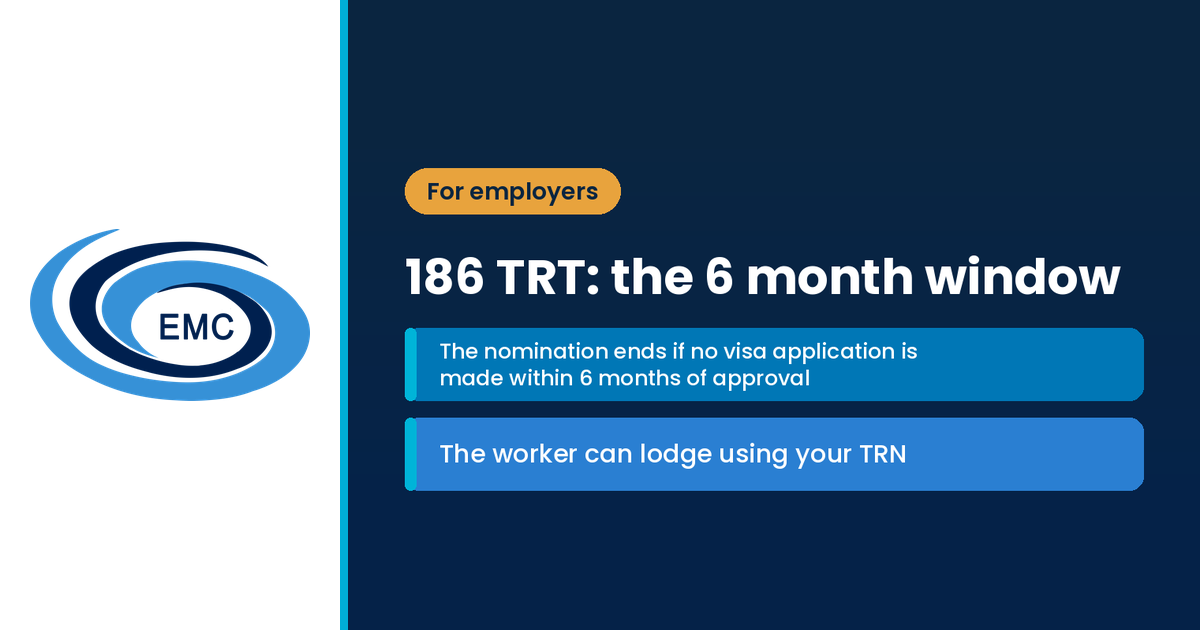
Home Affairs states that, if approved, your nomination will end if the employee you nominate does not apply for a subclass 186 visa within six months of the nomination approval. The Migration Regulations reflect the same rule, because a visa application in this stream must be made no more than six months after the nomination was approved.
In practice, this means an approved nomination is not open-ended. If the six months pass without a visa application, the approval ends. If you find yourself close to that point, or past it, get advice about your options before taking any further step.
Your worker does not have to wait for approval
Home Affairs explains that when you submit the nomination, you receive a nomination Transaction Reference Number, often called a TRN. Your worker needs that number to apply for the visa, and Home Affairs says they do not need to wait for the nomination to be approved before lodging their visa application.
Lodging early can help stop the six-month window passing unnoticed. However, if the nomination is not approved or is withdrawn, or the position is no longer available, the visa cannot be granted, and Home Affairs cannot link a new nomination to the existing visa application.
What Home Affairs says you must do as the nominator
Home Affairs states that, among other requirements, you must currently sponsor the applicant on a subclass 457 or 482 visa, and agree to employ them on a full-time basis for at least two years. Home Affairs explains that the worker must hold, or have most recently held, a subclass 457 or 482 visa, or a bridging visa granted when they applied for a subclass 457, 482, 186 or 187 visa. You can only nominate the worker while you remain their most recently approved sponsor.
Your business must also actively and lawfully operate in Australia and have a genuine need for a paid employee to fill a skilled position. You must be able to offer a skilled position that is full time and ongoing for at least two years, and the employment contract must not limit the position to two years.
Unless the worker will earn at or above a high salary threshold set out by Home Affairs, you must pay them at least the annual market salary rate. You must show that the applicant is eligible for any licence, registration or membership needed at the time you submit the nomination, and the nominated occupation must be the same as your most recently approved nomination for the applicant.
You must employ the worker on terms and conditions no less favourable than those for Australian citizens or permanent residents doing the same work in the same place, and comply with Australian immigration and workplace relations laws.
Check your worker's eligibility first
Home Affairs says that if the employee is not eligible at the time you apply to nominate them, it might refuse your nomination application. For this stream, workers usually need a total of at least two years of full-time eligible sponsored employment in Australia in the three years before they apply for the visa. This work must be in an occupation they were granted a subclass 457 or 482 visa for, while holding a 457, 482 or eligible bridging visa.
Your worker must also meet the other visa requirements, including the age requirement (usually under 45, with some exemptions) and Competent English. Checking this before you submit the nomination helps you choose the right time to start.
Practical steps for employers
Agree the visa lodgement timing with your worker before you submit the nomination.
Give your worker the TRN as soon as you have it, so they can prepare and lodge their visa application.
Record the approval date and the date six months later, with reminders well before the deadline.
Keep the nominated position available to your worker while the process is under way, because the regulations require the position to still be available to the applicant. Get advice before making any changes to the role.
We can prepare the nomination and coordinate the timing with your worker.
Read our guide to work and skilled visas
Read about the Employer Nomination Scheme visa (subclass 186)
Read what employers need to know about the 186 Direct Entry stream
Official sources
Read the Home Affairs page for the subclass 186 Temporary Residence Transition stream
Read the Migration Regulations 1994 on the Federal Register of Legislation
To talk about your situation, Book a Consultation from the top of this page, or message us on WhatsApp on +61 478 278 410.
General information only, not legal advice. EMC Australia, MARN 1800335.
Book a Consultation
General information only, not legal advice. EMC Australia, MARN 1800335.