
Sponsoring a worker for permanent residence
Many businesses find a skilled worker they want to keep for the long term. The Direct Entry stream of the Employer Nomination Scheme (subclass 186) is one way an Australian employer can nominate a worker directly for permanent residence. Before you start, it helps to understand what the Department of Home Affairs expects from the business side of the application.
What your business must show
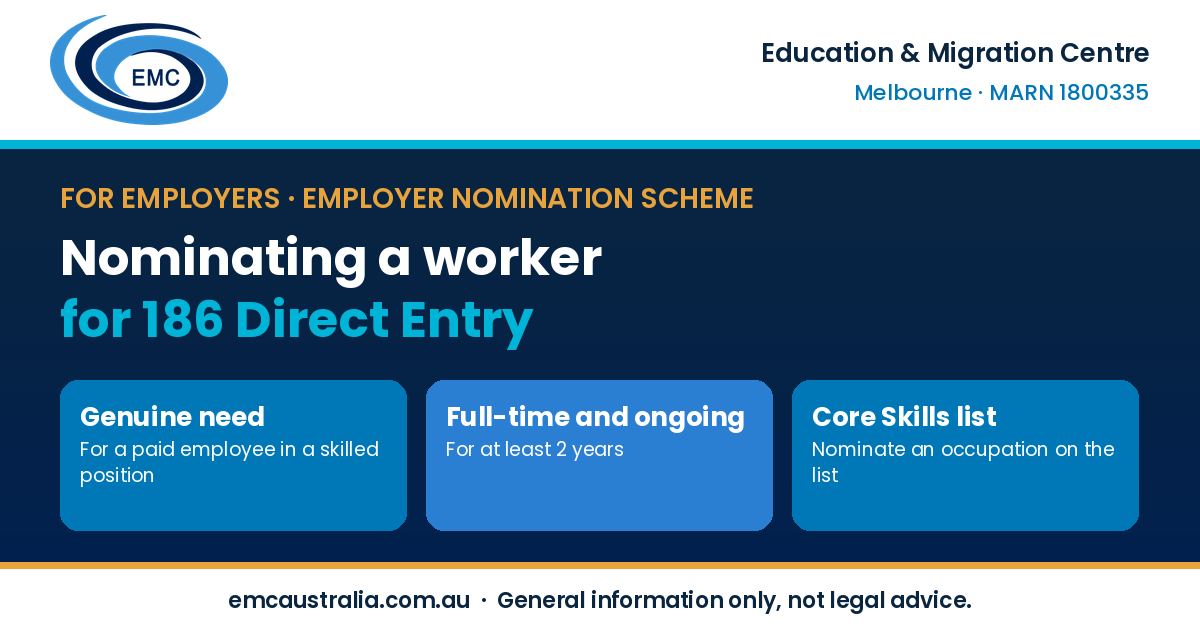
According to Home Affairs, your business must actively and lawfully operate a business in Australia, and must have a genuine need for a paid employee to fill a skilled position.
The position you offer must be full time and ongoing for at least 2 years. The employment contract must not limit the position to 2 years, so check the wording of the contract carefully before you lodge.
The occupation you nominate must be on the Core Skills Occupation List. You must pay the worker in line with the salary requirements, which include paying at least the annual market salary rate where that applies. Your business must also have complied with Australian immigration and workplace relations laws. You must employ the worker on terms and conditions, including salary, hours and leave, that are no less favourable than an Australian citizen or permanent resident would receive for the same work in the same place. The costs of sponsorship must not be passed on to the worker.
Home Affairs also expects that there is no adverse information known about your business or any person associated with it, unless it is reasonable to disregard that information. If the job requires a licence, registration or professional membership, you need to show that the worker is eligible for it when you lodge.
Showing a genuine need for the position
Home Affairs asks businesses to demonstrate that there is a genuine need to employ a person in the role. Home Affairs asks for a detailed organisational chart, the name of the occupation and its occupation code, and a detailed position description setting out the tasks and duties. Where relevant, you can also provide evidence of an increase in business activity, increased overtime, or that the position existed before and has become vacant through attrition.
The clearer your evidence, the easier it is for the case officer to see why the role is needed. A position description that reflects the real tasks and duties of the job is far more helpful than a generic one.
Setting and explaining the salary
If you rely on salary surveys to show how you set the salary, label them clearly and explain how you arrived at the figure. Home Affairs states that unlabelled salary surveys or vague details about how the salary was worked out may lead to the nomination being refused. Taking the time to set out your reasoning in plain terms can make a real difference.
Occupations with caveats
Some occupations carry caveats, which can exclude them from the Employer Nomination Scheme in certain circumstances. For example, a chef position cannot be in a fast food or takeaway food service. If a caveat could apply to the role you are nominating, provide evidence that shows the position falls outside it.
Timing after the nomination
Once the nomination is approved, the worker must apply for the visa within 6 months. The worker does not have to wait for approval, though. They can lodge their visa application before the nomination is approved, using the nomination's Transaction Reference Number, which the business receives when it submits the nomination.
Planning the nomination and the visa application together can help avoid delays and keep everyone on the same timeline.
Read the official requirements
Home Affairs sets out the full employer and worker requirements for this stream on its Direct Entry page.
Read the Home Affairs page on the 186 Direct Entry stream
How we can help
A nomination is much stronger when the evidence is organised and clearly explained from the start. We can prepare the nomination and the supporting evidence with you, and help you check that the position, contract and salary details line up before you lodge.
Read our guide to work visas and employer sponsorship
See our other recent migration updates
To talk about your situation, Book a Consultation from the top of this page, or message us on WhatsApp on +61 478 278 410.
General information only, not legal advice. EMC Australia, MARN 1800335.