Understanding the S48 Rule for Partner Visa Applications
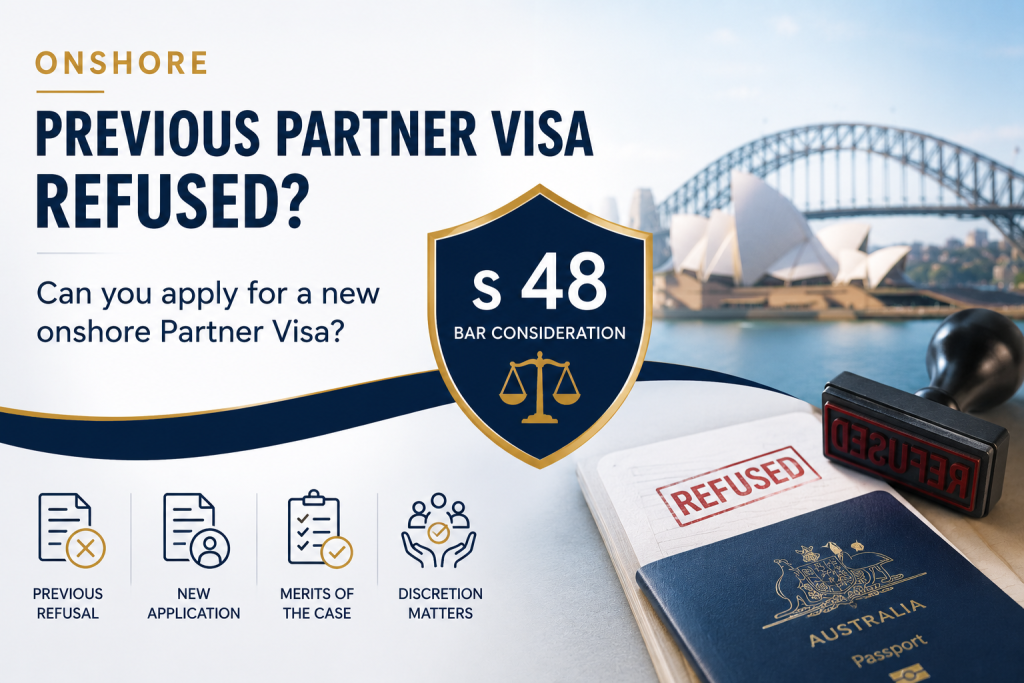
Can I apply for an onshore Partner Visa if my previous onshore Partner Visa was refused? In relation to this, the S48 rule should be considered.
No. If you do not hold a substantive visa (for example, you are on a bridging visa) and you have already had a Partner Visa refused since you last entered Australia, you are legally prevented from lodging a new onshore Partner Visa application. You will generally need to apply from outside Australia.
When navigating Australian migration law, experiencing a change in your personal life—such as getting married or welcoming a child—brings a lot of joy. Naturally, many people assume that these significant life events will automatically clear a path for a new visa application.
However, your immigration history plays a major role in your future options. If you have experienced visa refusals in the past, the rules become highly specific. To explain how these rules work in plain English, we will look at a common case study.
The Case Study: Marcus and Sarah
To understand how the Department of Home Affairs assesses these situations, let’s look at the scenario of Marcus.
Marcus arrived in Australia 10 years ago. After his arrival, he applied for an onshore Subclass 820 Partner Visa with his then-girlfriend. Unfortunately, that relationship ended, and the visa application was refused. Wanting to remain in Australia, Marcus then applied for a Protection Visa. This application was also refused. Today, Marcus is living in Australia and holds a Bridging Visa C.
Recently, Marcus married Sarah, who is an Australian citizen. Together, they have a 1-year-old baby who is also an Australian citizen.
Because Marcus is in a genuine marriage and has an Australian child, he wants to lodge a new onshore Partner Visa application so he can stay with his family.
While it seems logical that his new marriage and child should allow him to apply, under current Australian legislation, Marcus cannot lodge this application from within Australia. Here is a clear breakdown of the rules that prevent it.
The General Restriction on Onshore Applications
The first hurdle Marcus faces is a standard rule in the Migration Act 1958 known as Section 48.
This rule applies to any non-citizen inside Australia who does not hold a substantive visa (meaning they are on a bridging visa or are unlawful) and who has had a visa refused or cancelled since they last arrived in the country.
Because Marcus is on a Bridging Visa C and has had two visas refused (a Partner Visa and a Protection Visa), this restriction applies directly to him. The core purpose of this rule is to prevent individuals from remaining in Australia indefinitely by lodging endless visa applications one after another. When this restriction applies, the individual is blocked from applying for most visas while they remain in the country.
The Exemption for Partner Visas
If you look at the basic guidelines for this restriction, you will find a list of specific visas that are exempted. This means the government does allow people with a refusal history to apply for a small handful of visas from within Australia.
The onshore Partner Visa is on this exemption list.
Because of this, many people in Marcus’s position assume they are cleared to apply. They see that Partner Visas are exempt from the general restriction, so they fill out the forms and pay the application fees. However, this is where a critical legal detail often catches people out.
The Specific Rule About Previous Partner Visas
While Partner Visas are generally exempt from the restriction, there is an additional, strict requirement that you must meet just to submit the application.
The law states that if you are under the general restriction we mentioned above, you can only apply for a new onshore Partner Visa if the visa you previously had refused was a different kind of visa. You must not have been refused a Partner Visa since you last entered Australia.
Because Marcus’s previous refusal years ago was for a Subclass 820 Partner Visa, he fails this specific requirement. The law prevents him from having a second attempt at the same visa category while he remains in Australia.
Marcus’s situation is complicated further by his second refusal. Because his previous application for a Protection Visa was also refused, an additional restriction applies to him.
This specific rule prevents anyone who has had a Protection Visa refused from making any further applications for a Protection Visa while they are in Australia. This applies even if their circumstances have changed entirely. Therefore, Marcus is also prevented from attempting a new Protection Visa application.
Understanding Visa Validity vs. Visa Approval
A common question we receive at EMC Australia is:
Will having an Australian child override these restrictions?
Many people read about a “Schedule 3 Waiver,” which allows the government to overlook an applicant’s bridging visa status if there are strongly compassionate circumstances. Having an Australian-citizen child is widely recognised as a compelling circumstance that can help a family stay together.
To understand why this does not help Marcus apply onshore, it is helpful to look at the visa process as two separate doors.
Making a Valid Application
Before a case officer can look at your relationship, your family, or your personal circumstances, the application itself must be legally valid. The system checks basic facts: Are you in the right location? Have you paid the correct fee? Are you legally restricted from applying based on your history?
If you do not meet these initial rules, the application is deemed “invalid.” The first door remains closed, and the application cannot proceed.
Assessing the Visa Criteria
If your application passes the first door, it moves to the assessment stage. This is where the case officer looks at your evidence. They assess whether your relationship is genuine, and they review any compelling circumstances like having an Australian child to see if a waiver should be granted.
Because Marcus had a previous Partner Visa refused, the law says he cannot get through validity requirement. His application is legally invalid the moment it is submitted. Because the application cannot be accepted into the system, a case officer will never have the legal authority to open his file, review his relationship with Sarah, or consider his Australian-citizen child. The compassionate circumstances are never assessed because the application itself is blocked at the starting point.
The Pathway Forward
When an individual faces these overlapping restrictions, attempting to lodge an application without professional guidance often leads to an invalid application. It is likely that you will get your visa fee returned.
For someone in Marcus’s position, the legally viable pathway to secure a Partner Visa is to depart Australia and submit an offshore Partner Visa application (Subclass 309/100).
By leaving the country and applying from overseas, Marcus is no longer affected by the onshore restrictions that apply to bridging visa holders with past refusals. While applying from offshore involves a period of separation for the family, it removes the strict legal barriers that make an onshore application impossible.
Australian migration law requires careful planning, especially when your history includes previous refusals. Consulting with OMARA Registered Migration Agents ensures that your complete visa history is evaluated against current legislation before you make any decisions.
At EMC Australia, our team is dedicated to providing clear, factual, and practical guidance to help you keep your family together through the correct legal channels.
Disclaimer: The information provided in this publication is for general educational purposes only and does not constitute formal legal or migration advice. Australian migration regulations and departmental policies change frequently. For personalized legal guidance tailored to your visa history, please consult a Registered Migration Agent at EMC Australia.
Interested in personalised guidance for your Australian visa? 👉 Book Your Appointment
EMC Australia | Education & Migration Centre Australia Registered Migration Consultants & International Education Advisors Website: emcaustralia.com.au