
Many couples apply for a Partner visa in Australia when the applicant's own visa has already ended, or when they hold only a bridging visa. That is possible in some cases, but the law sets extra requirements, known as the Schedule 3 criteria, for people in this position.
What counts as a substantive visa
The Migration Act defines a substantive visa as any visa other than a bridging visa, a criminal justice visa or an enforcement visa. This means that if you are in Australia on a bridging visa, you do not hold a substantive visa, even though you are lawfully in Australia.
Check your current visa, its conditions and its expiry date before you apply, using Visa Entitlement Verification Online, known as VEVO.
When Schedule 3 applies
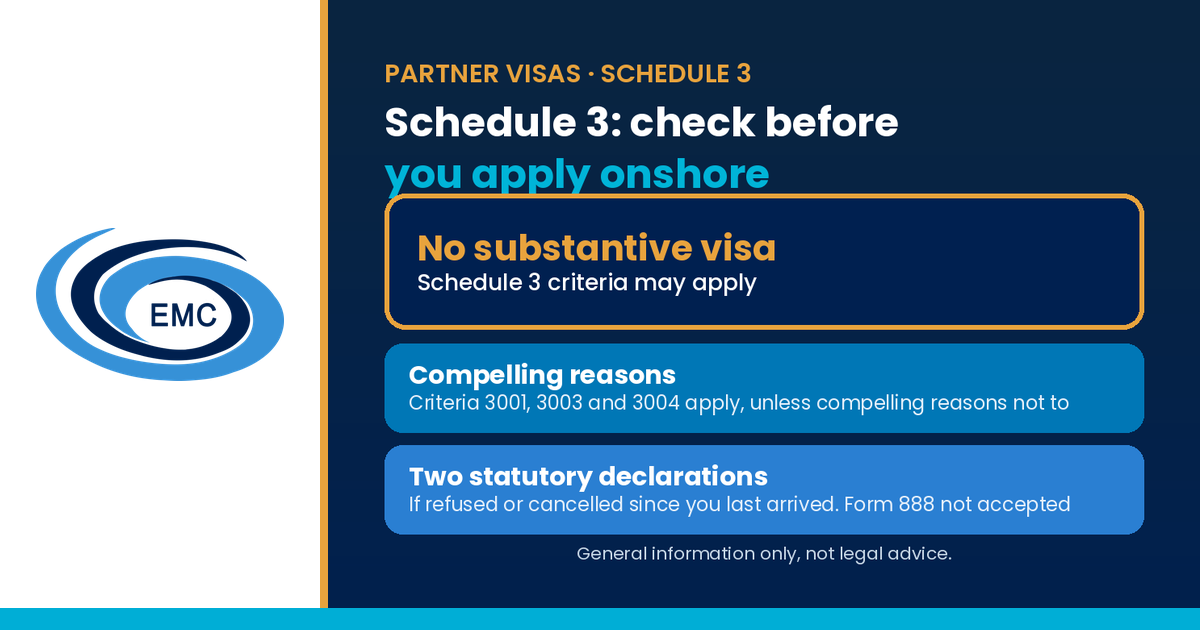
For the onshore Partner visa (subclass 820/801), the Migration Regulations require an applicant who does not hold a substantive visa when they apply to satisfy Schedule 3 criteria 3001, 3003 and 3004, unless the Minister is satisfied that there are compelling reasons for not applying those criteria.
Home Affairs describes this rule for applicants who did not previously hold a Prospective Marriage visa (subclass 300). Some former Prospective Marriage visa holders, such as those who married the person they came to Australia to marry, are assessed under separate rules. A small group of people who entered Australia on a diplomatic visa, or as certain visiting forces members, are also assessed against a different Schedule 3 criterion instead.
What the criteria look at
In summary, criterion 3001 relates to timing. It asks whether the application was made within 28 days after the relevant day, which for most people is the last day they held a substantive visa. Criterion 3003 covers a much narrower group of people who have not held a substantive visa since 1 September 1994.
Criterion 3004 looks at several matters together. These include whether the reason you do not hold a substantive visa is due to factors beyond your control, whether there are compelling reasons for granting the visa, whether you substantially complied with the conditions of your last substantive visa and any later bridging visa, and whether you intend to comply with the conditions of the visa you are seeking.
Compelling reasons
Home Affairs states that if you do not hold a substantive visa when you apply, and you did not previously hold a Prospective Marriage visa, you must demonstrate that compelling reasons exist for the grant of a Partner visa. Whether compelling reasons exist depends on the facts of each case, so explain your circumstances clearly and support them with evidence.
Who must provide statutory declarations
A separate rule applies if you are in Australia without a substantive visa and, since you last entered Australia, you have had certain visas refused or cancelled. The Migration Act limits which visas a person in that situation can apply for in Australia. If you can still apply for a Partner visa, you must not have been refused a Partner visa (including older Spouse or Interdependency visas) since you last entered Australia, and you must include certain documents when you lodge.
These include your sponsor's completed sponsorship form, evidence of your sponsor's status and at least two statutory declarations. Each declaration must be made within the six weeks before you apply, by an Australian citizen, Australian permanent resident or eligible New Zealand citizen who is not your partner, confirming that you and your partner are in a married or de facto relationship. Home Affairs also asks for evidence of each declarant's status, such as a passport or birth certificate.
Home Affairs states that Form 888 is not a statutory declaration and is not accepted for this purpose. If the sponsorship form or the two statutory declarations are not included when you lodge, the application is not valid.
Other limits to check
Other limits can also apply. Home Affairs explains that you can apply if your current or previous visa does not have a condition that prevents further stay. You might be able to request a waiver of that condition in some circumstances, but the waiver must be approved before you can apply.
Preparing your application
A Schedule 3 application needs careful preparation, and lodging an application does not mean it will be granted. Check your visa history, work out which rules apply to you, and gather your evidence early. We can review your situation and explain your options before you lodge.
Read our guide to Partner visas
Read about the onshore Partner visa (subclass 820/801)
Read about reapplying for a Partner visa after a refusal
Read about the two stages of the onshore Partner visa
Official sources
Read the Home Affairs page for the Partner visa (subclass 820)
Read the Migration Regulations on the Federal Register of Legislation
To talk about your situation, Book a Consultation from the top of this page, or message us on WhatsApp on +61 478 278 410.
General information only, not legal advice. EMC Australia, MARN 1800335.
Book a Consultation
General information only, not legal advice. EMC Australia, MARN 1800335.