
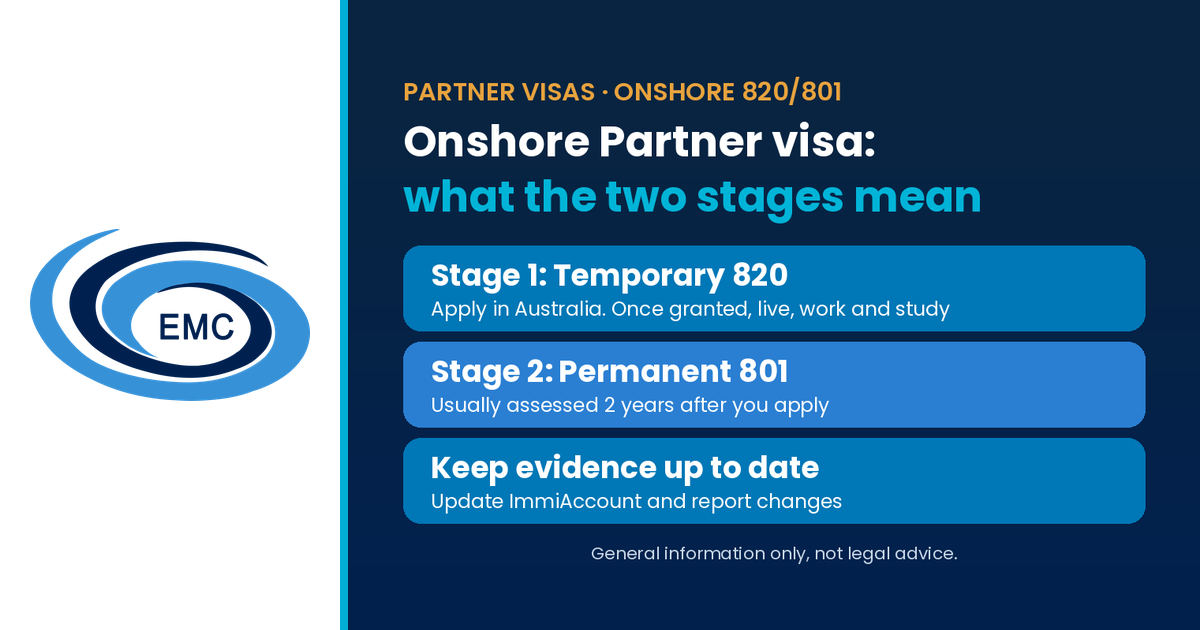
If you are in Australia and your partner is an Australian citizen, an Australian permanent resident or an eligible New Zealand citizen, the onshore Partner visa may be the pathway you are considering. It has two stages: the temporary Partner visa (subclass 820) and the permanent Partner visa (subclass 801). You apply for both together, and the two stages are then considered at different times.
Stage one: the temporary Partner visa (subclass 820)
You must be in Australia when you apply, and family members who apply with you must also be in Australia. You can be in or outside Australia when the temporary visa is decided.
Some people cannot apply in Australia. Home Affairs explains that this can be the case if your current or previous visa has a no further stay condition that has not been waived, or if you do not hold a substantive visa and have had a visa refused or cancelled. Check this before you lodge.
Once the subclass 820 is granted, you can live, work and study in Australia while your permanent Partner visa is processed. You can also travel to and from Australia as many times as you want while you hold the visa, and apply for access to Medicare. If you are eligible, you can attend English classes through the Adult Migrant English Program.
You can stay on the subclass 820 until your permanent Partner visa application is finalised or you withdraw your application.
Stage two: the permanent Partner visa (subclass 801)
According to Home Affairs, you become eligible to be assessed for the subclass 801 two years after you first applied for the temporary and permanent Partner visas. You can check the date you submitted your applications in ImmiAccount. The processing time for the permanent visa starts from this date of eligibility, so do not send your permanent stage documents before then.
When the permanent stage is assessed, you must, in most cases, continue to be in a genuine and ongoing relationship with your sponsor. You cannot change your sponsor.
The permanent visa may be granted in less than two years if you were already in a long-term partner relationship with your sponsor when you applied. Under the Migration Regulations, this generally means you had been together for at least three years, or at least two years if you have a dependent child together. Whether this applies depends on your circumstances, so it is worth getting advice about your own relationship history.
If your relationship ends or your partner dies before the permanent visa is granted, you might still be eligible for the permanent visa. You may also still be eligible if your relationship has ended and you or a dependent child experienced family violence committed by your sponsor. These situations need careful advice.
Do not let another visa replace your 820
To be granted the subclass 801, you must hold the subclass 820. A dependent child can instead hold a Dependent Child visa (subclass 445). If you are granted any other visa, you will no longer be eligible for the grant of the permanent Partner visa.
New Zealand passport holders should tell the officer at the border that they hold a temporary Partner visa and do not want a Special Category visa (subclass 444). Home Affairs warns that a subclass 444 visa will override the temporary Partner visa. If you are thinking about applying for any other visa while you wait, get advice first.
Keep your application up to date while you wait
Because processing can take a long time, Home Affairs recommends that you update your documents and evidence of your relationship regularly through ImmiAccount. Practical steps include keeping recent evidence of your shared finances, household and social life together, and of your commitment to each other.
You must also tell Home Affairs about changes in your situation, such as a change to your marital or de facto status, the birth of a child or any other change relevant to your application. Let it know if your contact details, address or passport change. If you did not attach every required document when you applied, attach the missing documents in ImmiAccount as soon as you can.
Every case is different
Eligibility can depend on your visa history, your relationship and your other circumstances, so we recommend getting advice before you lodge.
Read about the onshore Partner visa (subclasses 820 and 801)
Read what you can do while your Partner visa application is being processed
Read why everyday evidence matters for a Partner visa
Official sources
Read the Home Affairs page for the temporary Partner visa (subclass 820)
Read the Home Affairs page for the permanent Partner visa (subclass 801)
Read the Migration Regulations 1994 on the Federal Register of Legislation
To talk about your situation, Book a Consultation from the top of this page, or message us on WhatsApp on +61 478 278 410.
General information only, not legal advice. EMC Australia, MARN 1800335.
Book a Consultation
General information only, not legal advice. EMC Australia, MARN 1800335.