
If your partner is an Australian citizen, permanent resident or eligible New Zealand citizen and you live overseas, the offshore Partner visa is often the pathway couples look at first. This article explains how the two stages work, what Home Affairs expects when you apply, what to do while you wait, and what happens once the provisional visa is granted.
One application, two visas
The offshore Partner visa has two stages that are applied for together in one application. The first is the provisional Partner visa (subclass 309). The second is the permanent Partner visa (subclass 100). Home Affairs refers to you applying for the temporary and permanent Partner visas together, and it assesses the permanent stage later.
Being outside Australia when you apply
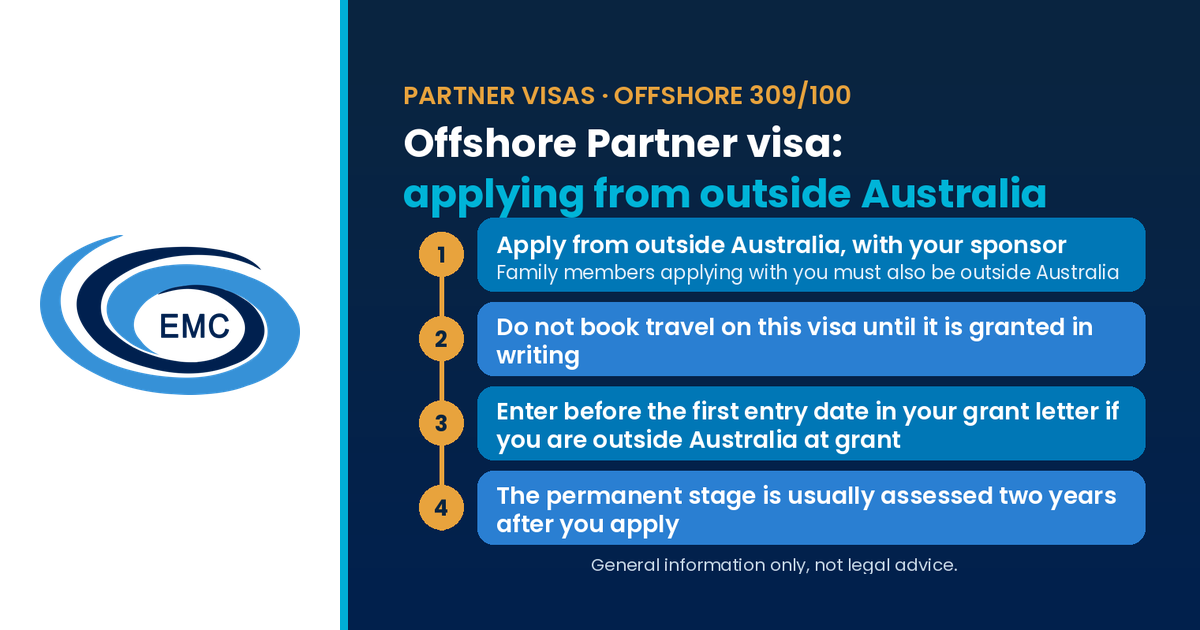
Home Affairs states that you must be outside Australia when you apply for this visa, and that family members who apply with you must also be outside Australia.
You must be in a genuine relationship with your spouse or de facto partner, who must be an Australian citizen, an Australian permanent resident or an eligible New Zealand citizen, and your partner must sponsor you. Home Affairs also states that you can be in or outside Australia when it decides your provisional visa application.
While you wait for a decision
Home Affairs is clear that you should not arrange to travel to Australia on this visa until it tells you, in writing, that the subclass 309 has been granted.
Home Affairs also asks you to give it your contact details when you apply and to tell it if they change. Because processing can be long, it recommends updating your documents and evidence of your relationship regularly through ImmiAccount.
After the subclass 309 is granted
If you are outside Australia when the subclass 309 is granted, Home Affairs states that you must enter Australia before the first entry arrival date shown in your grant letter. Check that date as soon as you receive your grant, and plan your move around it.
Home Affairs also explains that you can travel to Australia with an expired first entry arrival date if your visa is still valid. It adds that your visa may still be subject to cancellation before arrival or at the border, so it is sensible to get advice before travelling if that date has passed.
While you hold the subclass 309, you can live, work and study in Australia while the permanent stage is processed, and travel to and from Australia as many times as you want. You can also apply for access to Medicare, Australia's public health care scheme, if you are eligible.
To be granted the permanent subclass 100, you must still hold your subclass 309 visa. Home Affairs warns that if you are granted any other visa, you will no longer be eligible for the permanent Partner visa, so get advice before applying for any other visa.
When the permanent stage is assessed
Home Affairs states that you become eligible to be assessed for the permanent subclass 100 two years after you applied for the subclass 309 and 100 visas. You can check the date you lodged your application in ImmiAccount. If your permanent visa was not granted at the same time as your subclass 309, Home Affairs asks you to submit your documents for the permanent stage once two years have passed, and not before.
In some cases, the permanent visa may be granted sooner. Home Affairs lists two situations in which it might grant the subclass 100 in less than two years. The first is where you were already in a long-term partner relationship with your sponsor when you applied. Under the Migration Regulations, this generally means you had been together for at least three years, or at least two years if you have a dependent child together. The second is where your sponsor holds, or held, a permanent humanitarian visa, you were married or in a de facto relationship before that visa was granted, and Home Affairs was told about your relationship before the grant. Whether either situation applies to you depends on your circumstances.
Planning your application
Before you lodge, think about where you and your family members will be when you apply, how you will keep your relationship evidence up to date, and how you will plan your travel around the grant and the first entry date. We recommend getting advice before you lodge, so that your application is prepared with your own circumstances in mind.
Read our guide to Partner visas
Read about the offshore Partner visa (subclass 309 and 100)
Read how the onshore Partner visa (subclass 820 and 801) works in two stages
Official sources
Read the Home Affairs page for the Partner visa (subclass 309)
Read the Home Affairs page for the Partner visa (subclass 100)
To talk about your situation, Book a Consultation from the top of this page, or message us on WhatsApp on +61 478 278 410.
General information only, not legal advice. EMC Australia, MARN 1800335.
Book a Consultation
General information only, not legal advice. EMC Australia, MARN 1800335.