
The thresholds from 1 July 2026
If you sponsor skilled workers, three income thresholds matter. The figures below are set out in the explanatory statement for the Home Affairs Legislation Amendment (2026 Measures No. 1) Regulations 2026.
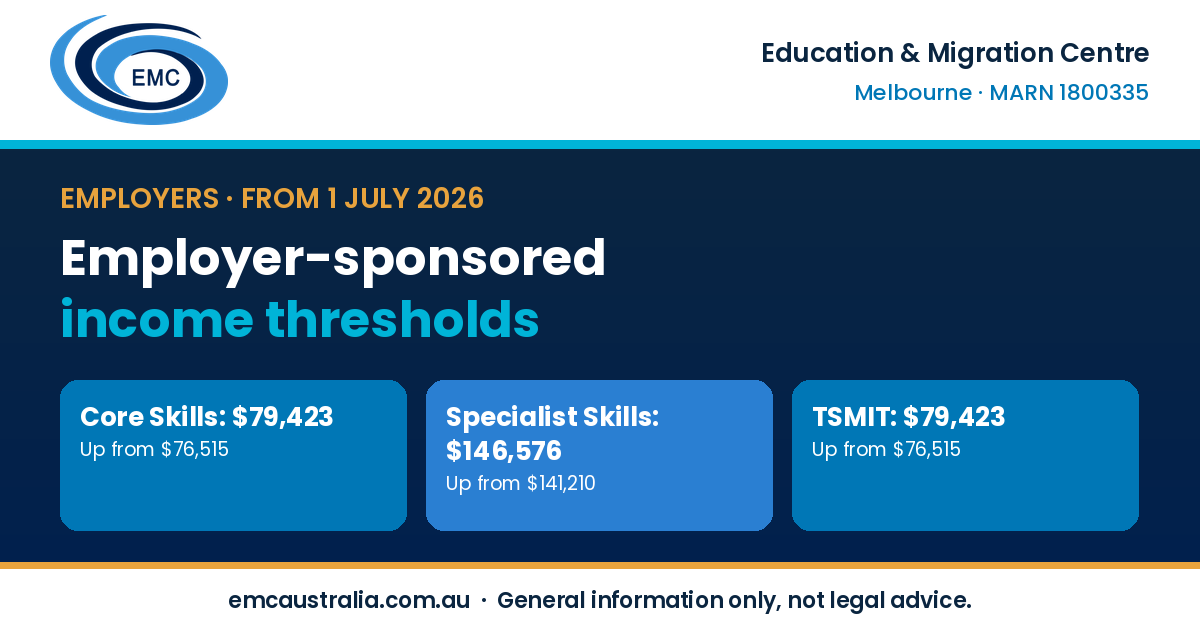
The Core Skills Income Threshold rose from $76,515 to $79,423.
The Specialist Skills Income Threshold rose from $141,210 to $146,576.
The temporary skilled migration income threshold rose from $76,515 to $79,423.
The explanatory statement says the income thresholds for the Skills in Demand visa (subclass 482) and the Employer Nomination Scheme visa (subclass 186) are set in the Migration Regulations 1994 and are indexed to average weekly ordinary time earnings.
Read the explanatory statement for the amending regulations
Read the amending regulations on the Federal Register of Legislation
What changed for the temporary skilled migration income threshold
According to the explanatory statement, this threshold applies to nominations for the Skilled Employer Sponsored Regional (Provisional) visa (subclass 494) and the Regional Sponsored Migration Scheme visa (subclass 187).
Until now, the Minister set this threshold each year in a separate legal instrument. The most recent one, from 1 July 2025, set it at $76,515, the same figure as the Core Skills Income Threshold.
The new regulations move this threshold into the Migration Regulations 1994 themselves. From 1 July 2026, the Regulations set it at $79,423, and it will be indexed each year alongside the Core Skills Income Threshold. The first yearly indexation under the Regulations will be on 1 July 2027.
The explanatory statement says this does not change the policy intent, which is for the two thresholds to stay the same each 1 July. It says the change gives greater certainty because indexation will now happen under the Regulations.
Read the Migration Regulations 1994 on the Federal Register of Legislation
Which nominations the new figure applies to
The changes to the temporary skilled migration income threshold apply to nomination applications made on or after 1 July 2026.
Why the thresholds matter
The explanatory statement explains that, for these visas, the Minister must be satisfied of three things. The pay for an equivalent Australian worker must be at least the threshold. The nominated worker must be paid at least the same as an equivalent Australian worker. And the nominated worker's guaranteed annual earnings, not counting non-cash benefits, must be at least the threshold.
It also says indexation is meant to help migrant workers support themselves in Australia, and that requiring employers to pay at least the higher threshold helps to address the risk of worker exploitation.
What employers should check
Before lodging a new nomination, confirm that the guaranteed annual earnings meet the current threshold for the visa. Remember that the threshold is only a minimum. Where the worker will earn less than $250,000 a year, the salary must also be at least the market salary rate for the role. Note 1 July in your calendar each year, as the thresholds are usually indexed on that date.
Related reading
Read our overview of Australian work visas
Read our guide to the 482, 186 and 494 employer-sponsored visas
See our other recent migration updates
To talk about your situation, Book a Consultation from the top of this page, or message us on WhatsApp on +61 478 278 410.
General information only, not legal advice. EMC Australia, MARN 1800335.