
Why the market salary rate matters
When you nominate a worker for an employer-sponsored visa, you must show that the worker will be paid fairly. Where the worker will earn less than $250,000 a year, the Minister must be satisfied that the worker will be paid at least the annual market salary rate for the role, not counting non-cash benefits. This is the rate an Australian worker doing the same job would be paid.
The $250,000 figure is set in a legislative instrument made under the Migration Regulations 1994, known as IMMI 18/033. Section 5 of that instrument says the specified amount of annual earnings is $250,000.
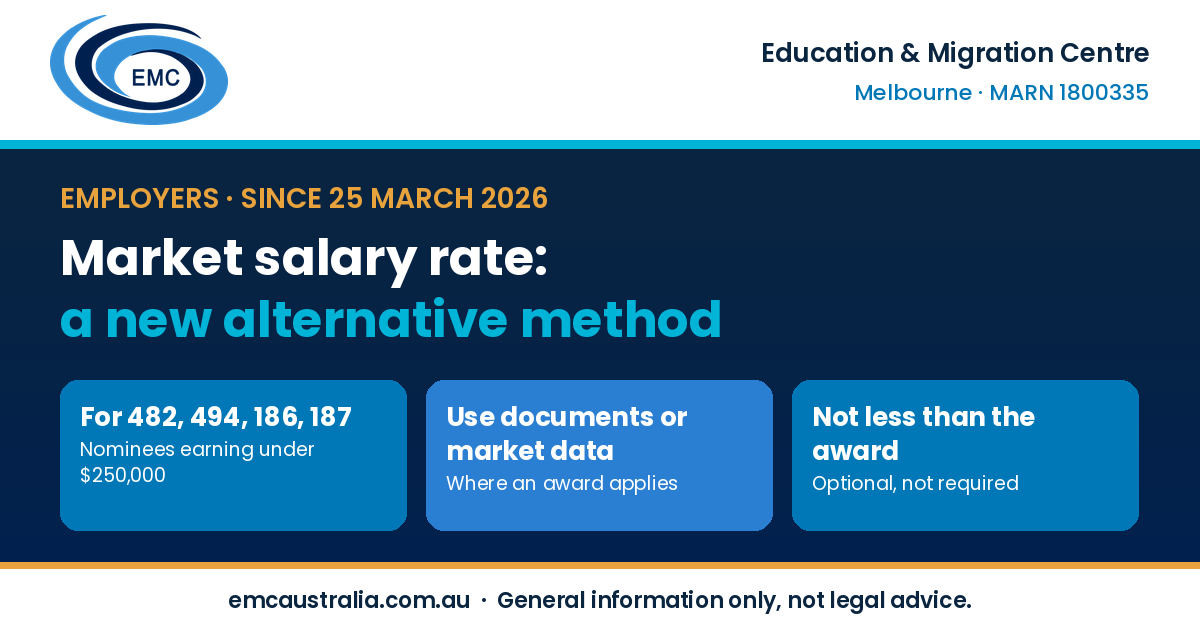
From 25 March 2026, the Migration Legislation Amendment (Annual Market Salary Rate) Instrument 2026 changed how the market salary rate can be worked out. It applies to nominations for the Skills in Demand visa (subclass 482), the Skilled Employer Sponsored Regional (Provisional) visa (subclass 494), the Employer Nomination Scheme visa (subclass 186) and the Regional Sponsored Migration Scheme visa (subclass 187).
Read the amending instrument on the Federal Register of Legislation
Read the explanatory statement for the amending instrument
How the rate was worked out before
The explanatory statement says that, before the change, where an award or other industrial instrument applied to the job, the market salary rate was the amount an equivalent Australian worker was paid, or would be paid, under that award or instrument.
Where no award or instrument applied, the rate was worked out from employment documents for an equivalent Australian worker or, if there was no such worker, from other relevant information.
The alternative method
Where an award or other industrial instrument applies, employers can now choose between two approaches.
If there is an equivalent Australian worker in your business, the market salary rate can be the pay set by the award, or it can be worked out from relevant employment documents, as long as the result is not less than the award amount.
If there is no equivalent Australian worker, the rate can be the pay that would apply to an equivalent Australian worker under the award, or it can be worked out from other relevant information, as long as the result is not less than the award amount.
What counts as documents and information
The instrument says relevant employment documents include pay slips and employment contracts, among other things.
Relevant information can include published government information about occupations and industries, English-language job advertisements on national recruitment websites or in national print media that state the salary, written advice from registered employer associations or unions, and industry pay surveys by a reputable organisation. This list is not complete.
Key limits
The alternative amount cannot be less than the amount in the award or other industrial instrument.
Using the alternative method is a choice. The explanatory statement says the changes allow employers to use it but do not require them to.
The change applies to nominations made on or after 25 March 2026, and to nominations that were made before that date but had not been decided by then.
The explanatory statement says the aim is a more accurate market salary rate that reflects current Australian wages and the variety of employment situations.
Read the instrument that sets the market salary rate rules
What employers should do
Before you lodge, decide which method fits the evidence you have. Keep the pay slips, contracts or market information that support the figure you use. Also check that the salary meets the current income threshold for the visa.
Related reading
Read our overview of Australian work visas
Read our guide to the 482, 494 and 186 employer-sponsored visas
To talk about your situation, Book a Consultation from the top of this page, or message us on WhatsApp on +61 478 278 410.
General information only, not legal advice. EMC Australia, MARN 1800335.