
Receiving a refusal on a Partner visa application is hard news, especially when you have built a life together. If you have applied for a review and your case is now before the Administrative Review Tribunal, known as the ART, the hearing is your opportunity to respond to the concerns that led to the refusal. Careful, early preparation can make a real difference to how clearly your case is presented.
This guide walks through the practical steps, based on the Tribunal's own guidance for people getting ready for a hearing.
Start with the refusal decision
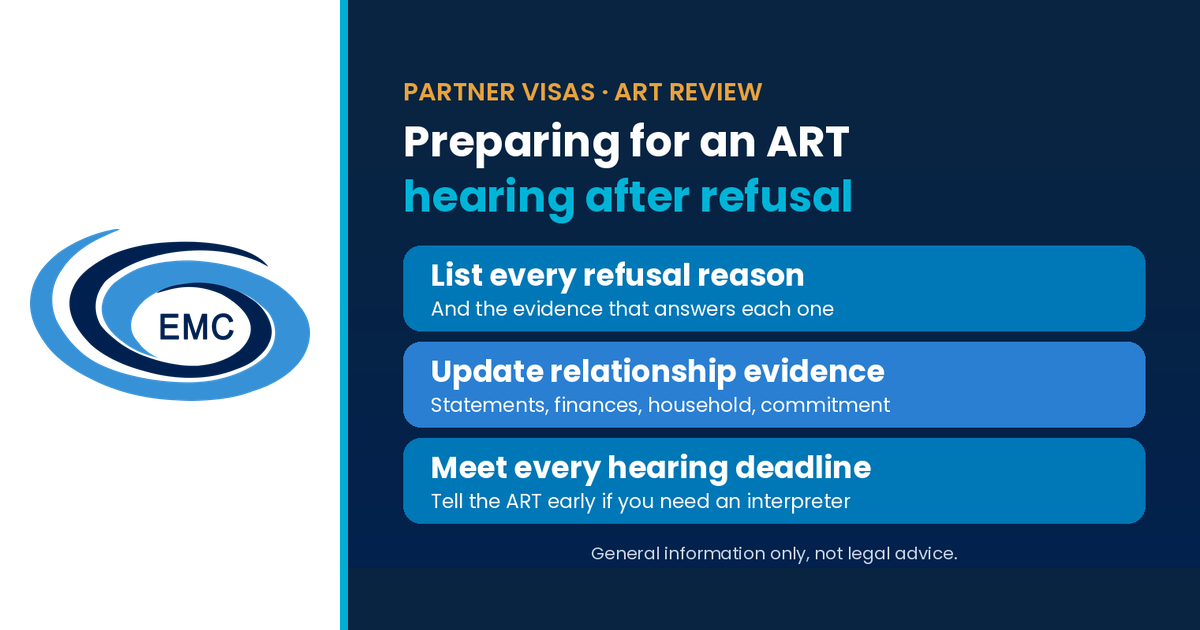
Read the refusal decision carefully, from start to finish. Make a list of every reason the decision maker gave for refusing the application. Next to each reason, write down the evidence you have, or can obtain, that responds to it.
This simple exercise keeps your preparation focused. A review is your chance to answer the specific concerns raised, so the most useful evidence is usually the evidence that speaks directly to those concerns.
The Tribunal says it takes a fresh look at the facts, law and policy and makes its own decision. This means it may also ask about other parts of your application, so make sure your evidence is up to date for all the requirements, not just the reasons for refusal.
Update your relationship evidence
When deciding whether a couple are in a genuine relationship, the Migration Regulations 1994 require the decision maker to consider all the circumstances of the relationship. These include the financial aspects of the relationship, the nature of your household, the social aspects of the relationship, and the nature of your commitment to each other.
It helps to bring your evidence up to date in each of these areas. Financial evidence might include joint accounts, shared bills or joint leases. Household evidence might show how you share your living arrangements and housework. Social evidence might show that friends, family and organisations know you as a couple. Evidence of commitment might show that you know about each other's background and family, that you stay in touch when apart, and that you see your relationship as a long-term one.
Prepare clear written statements from you and from your partner. Statements from people who know you as a couple can also help.
Translate documents that are not in English
The Tribunal's Common Procedures Practice Direction says that any document lodged with the Tribunal that is not in English must be accompanied by a NAATI certified translation into English. It also says the Tribunal may not accept evidence that is not in English without a certified translation. Translations can take time, so arrange them early enough for your translated documents to reach the Tribunal by the deadline explained below.
Read everything the Tribunal sends you
The Tribunal will write to you about what to do to get ready for your hearing. Its guidance asks you to read all the documents you have been given, including directions and letters, which explain which documents you must provide and when. Read your hearing letter carefully and meet every deadline it sets for sending documents.
The Tribunal's Common Procedures Practice Direction also says that, unless the Tribunal gives a different timeframe, documents you want to rely on at the hearing must be provided to the Tribunal at least 7 calendar days before the hearing. If your hearing letter or a direction gives a different date, follow that date.
Before the hearing, read every document you have been given, including your own earlier statements. Knowing your documents well helps you answer questions clearly and consistently.
Witnesses and interpreters
Think about who may be able to give evidence in support of your relationship. The Tribunal explains that any witnesses will be asked to give evidence at the hearing, and that the member and others present can ask each witness questions. Check the Tribunal's current guidance and your hearing letter for how to tell the Tribunal about witnesses.
If you need an interpreter, tell the Tribunal as early as possible. The Tribunal says it will arrange a qualified interpreter for the hearing, and that you cannot ask a relative or friend to interpret for you. Your hearing letter explains how to ask for one.
On the day of the hearing
Be ready early, whether your hearing is in person, by video or by phone. For a phone or video hearing, the Tribunal suggests charging your devices, choosing a quiet place, checking your phone signal and making sure your audio and video are working.
At the hearing you will be asked to take an oath or make an affirmation that you will tell the truth. Answer questions honestly and in your own words. If you do not understand a question, say so and ask for it to be repeated or explained.
Getting advice early
A review cannot promise a different outcome, but well-organised evidence and good preparation can help the Tribunal understand your relationship. We recommend getting advice as soon as possible after you receive your hearing letter, so there is time to gather evidence and statements before any deadline.
Read about visa refusals and appeals
Read how a genuine relationship is assessed
Official sources
Read about the Tribunal's role and how it reviews decisions
Read the Tribunal's guidance on getting ready for a hearing
Read the Tribunal's guidance on what happens during a hearing
Read the Tribunal's information on interpreters and language services
Find the Tribunal's practice directions, including the Common Procedures Practice Direction
Read the Migration Regulations 1994 on the Federal Register of Legislation
To talk about your situation, Book a Consultation from the top of this page, or message us on WhatsApp on +61 478 278 410.
General information only, not legal advice. EMC Australia, MARN 1800335.
Book a Consultation
General information only, not legal advice. EMC Australia, MARN 1800335.