
What changed on 1 November 2026
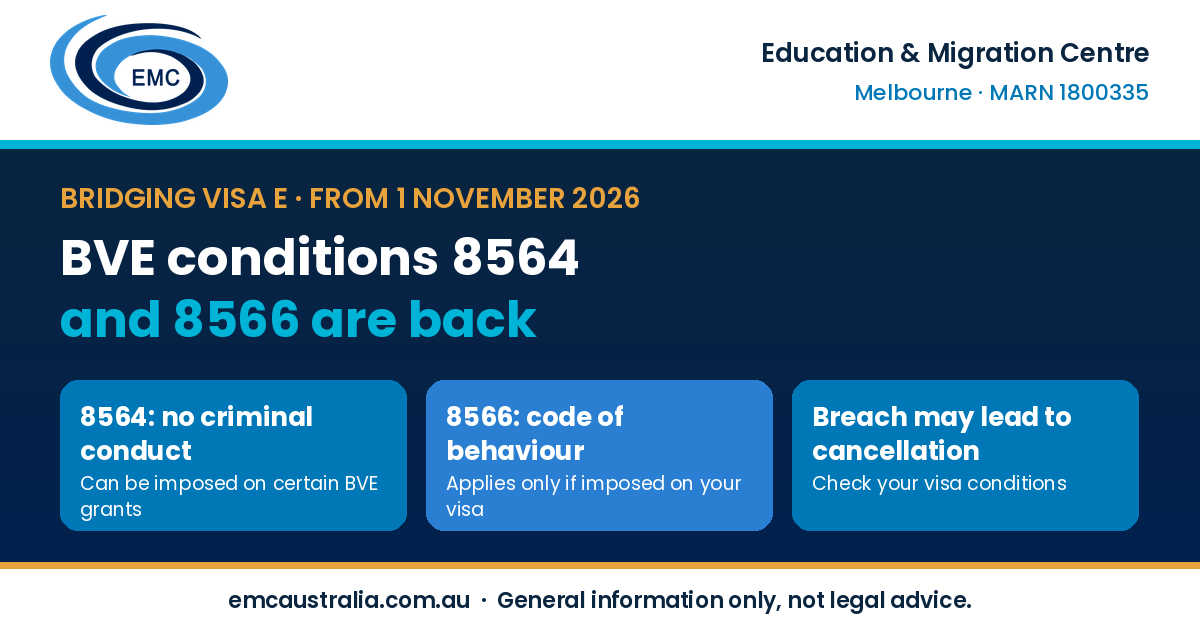
From 1 November 2026, the Minister can again choose to put two conditions on certain Bridging visas E (subclass 050). They are condition 8564, which is about criminal conduct, and condition 8566, which is about breaching a signed code of behaviour.
The change was made by the Migration Amendment (2026 Measures No. 1) Regulations 2026. The explanatory statement that accompanies them says the power to impose these conditions was unintentionally removed for certain Bridging visa E grants by earlier regulations made in 2024. The new regulations put that power back.
The amending regulations say these changes apply to visa applications made on or after 1 November 2026.
Read the amending regulations on the Federal Register of Legislation
Read the explanatory statement for the amending regulations
What the two conditions say
The wording of both conditions is in Schedule 8 of the Migration Regulations 1994.
Condition 8564 says: "The holder must not engage in criminal conduct."
Condition 8566 says that if the visa holder has signed a code of behaviour that the Minister has approved, and that code is in effect for that visa or another visa when the visa is granted, "the holder must not breach the code."
In plain terms, condition 8566 matters only if you have signed an approved code of behaviour that is in effect for that visa or another visa.
Read the Migration Regulations 1994 on the Federal Register of Legislation
These conditions are not on every Bridging visa E
The explanatory statement says imposing either condition is discretionary. The Minister may decide to impose them on a particular Bridging visa E when granting it. It also says the conditions only apply to visas that were granted with those conditions.
So the first step is to know exactly which conditions are on your visa. You can check this in your grant letter or through the government's online visa check service.
Read our guide to checking your visa status and conditions
What happens if a condition is breached
The explanatory statement explains the process. If a visa holder breaches a visa condition, their visa may be cancelled. Cancelling a visa for a breach is a decision the Department makes case by case, taking individual circumstances into account.
Before a Bridging visa E is cancelled, the Department will send the holder a notice saying it intends to consider cancelling the visa. This gives the holder a chance to respond.
If a Bridging visa E is cancelled for breaching condition 8564 or 8566 and the person does not hold any other visa, they become an unlawful non-citizen. Depending on the circumstances, they may then be liable to be detained and removed from Australia under the Migration Act 1958.
Why the government made this change
The explanatory statement describes the conditions as an additional tool for the Minister to help keep the community safe. It also says granting a Bridging visa E may be an appropriate alternative to detention in some circumstances.
What you should do
Check the conditions on your Bridging visa E and keep a copy of your grant letter. If you signed a code of behaviour, keep a copy and read it carefully. If you receive a notice that the Department intends to consider cancelling your visa, respond within the time given in the notice and get advice straight away.
Related reading
Read our guide to bridging visas
Read our guide to the Bridging visa E and staying lawful
Read the Home Affairs Bridging visa E page
To talk about your situation, Book a Consultation from the top of this page, or message us on WhatsApp on +61 478 278 410.
General information only, not legal advice. EMC Australia, MARN 1800335.