
If an Australian employer wants to sponsor you for a Skills in Demand visa (subclass 482) in the Core Skills stream, your work history will be an important part of your application. The law sets a specific work experience test, and understanding it early helps you gather the right evidence. This article explains the requirement, what Home Affairs says about related work, and how to prepare.
What the law requires
The Migration Regulations 1994 set out the work experience requirement for the Core Skills stream. You must have carried out work in your nominated occupation or a related field. That work can have been full-time, part-time or casual.
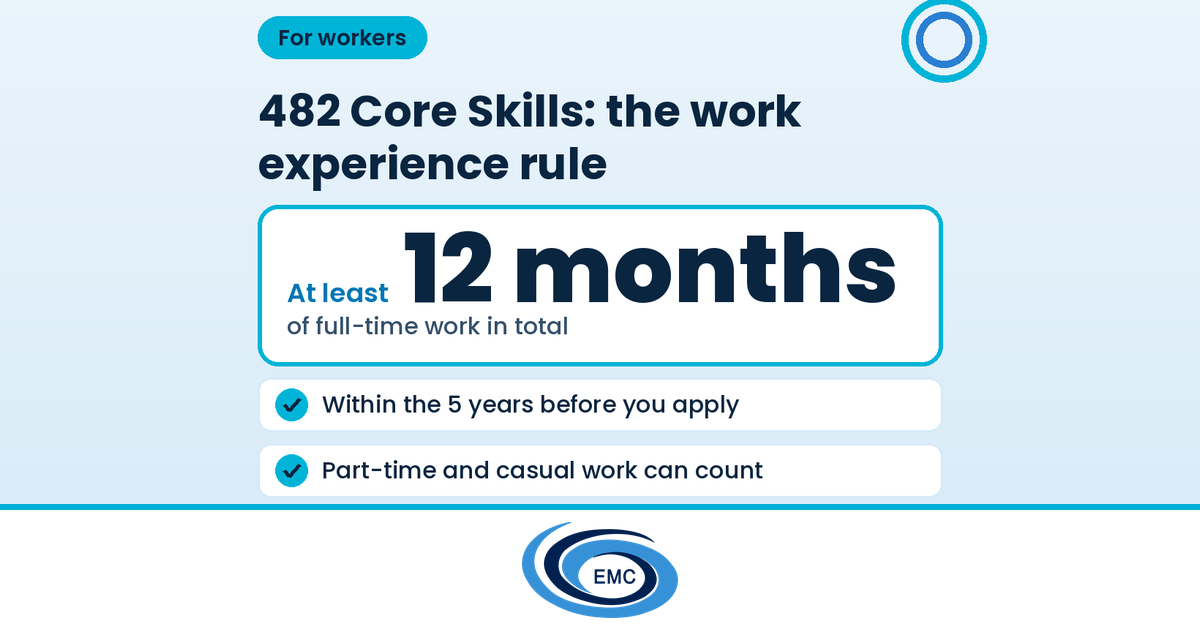
The total period of work must be, or be equivalent to, at least 12 months of full-time work. The work must have been carried out during the 5 years ending immediately before the day you apply for the visa.
In simple terms, part-time and casual work can count, but it must add up to the equivalent of at least 12 months of full-time work, and all of it must fall within that 5-year window.
What counts as a related field
Home Affairs explains that work experience must be completed while working in the nominated occupation, or while performing tasks at the same skill level in a related field.
Work in a related field involves tasks that are the same as, or closely related to, the tasks of the nominated position, as described in the Australian and New Zealand Standard Classification of Occupations, known as ANZSCO. Comparing your actual duties with the ANZSCO description of your nominated occupation is a useful first step.
Your work does not need to be continuous
Home Affairs states that the period of work does not need to be continuous. If you have had breaks between jobs, or have worked part-time for some periods, those periods can still be added together, as long as the total meets the requirement and the work falls within the 5 years before you apply.
Experience gained through study
Home Affairs also describes other ways you may be able to demonstrate work experience. These include experience gained as part of a Masters or PhD, for relevant occupations such as medical and research occupations, and experience gained while studying through a formal arrangement, such as a clinical or industry placement, internship or apprenticeship.
Home Affairs sets conditions for this. If the formal arrangement was part of a CRICOS registered course, the study must have been relevant to the nominated occupation. If it was not part of a CRICOS registered course, the study must have been undertaken at the skill level of the relevant occupation.
Other requirements to keep in mind
Work experience is only one part of the Core Skills stream. Your employer must nominate you for an occupation on the Core Skills Occupation List, known as the CSOL. You must also have the skills, qualifications and employment background needed to perform the tasks of the nominated occupation, and some applicants must have a skills assessment. If a skills assessment is mandatory for your occupation, Home Affairs states that it must be commenced before you lodge your visa application, otherwise the application will not be valid.
Preparing your evidence
Home Affairs asks for employment references on the employer's letterhead that include the referee's name, title and contact details, your position and your dates of service. It also asks for a CV or resumé with your full employment and educational history, including dates and positions held, for at least the last 5 years.
Before you apply, gather references and records that show your duties, dates and hours. Gaps or part-time periods are easier to explain when the evidence is ready early. We can review your work history against the requirement with you.
Read our guide to work and skilled visas
Read about the Skills in Demand visa (subclass 482)
Read our overview of skills assessments
Official sources
Read the Home Affairs page for the Skills in Demand visa Core Skills stream
Read the Migration Regulations 1994 on the Federal Register of Legislation
To talk about your situation, Book a Consultation from the top of this page, or message us on WhatsApp on +61 478 278 410.
General information only, not legal advice. EMC Australia, MARN 1800335.
Book a Consultation
General information only, not legal advice. EMC Australia, MARN 1800335.